
How to Rate an Intelligence Source
A practical way to rate sources on reliability and information on credibility — the analyst's discipline, made usable by teams that don't have an analyst.
By Arcline Team
When you act on open-source information, you're making two separate judgments whether you name them or not: how much you trust the source, and how much you trust this particular piece of information. Conflating them is how teams get burned — a reliable outlet can carry an unconfirmed rumor, and a sketchy account can be first with something true.
This is one way to keep the two judgments distinct, adapted from a system intelligence professionals have used for decades. It's a mental discipline more than a form; use as much of the structure as helps.
Two axes, not one
The core idea, from the NATO/Admiralty system, is that source and information get rated independently.
Reliability of the source — a track-record judgment, as a letter:
- A — Reliable: consistently accurate over many instances. Rare. Earned.
- B — Usually reliable: right most of the time, occasional misses.
- C — Fairly reliable: mixed but useful with corroboration.
- D — Not usually reliable: more often wrong than right.
- E — Unreliable: demonstrated pattern of inaccuracy.
- F — Cannot be judged: no track record. New source, first contact.
Credibility of the information — a judgment about the specific item, as a number:
- 1 — Confirmed: corroborated by independent, unrelated sources.
- 2 — Probably true: consistent with other known information, not yet independently confirmed.
- 3 — Possibly true: plausible, some support, uncorroborated.
- 4 — Doubtful: possible but uncorroborated and somewhat against known facts.
- 5 — Improbable: contradicts other reliable information.
- 6 — Cannot be judged: no basis to assess.
A report gets both marks. "B2" — usually-reliable source, probably-true information. "F3" — unknown source, plausible-but-uncorroborated item. Two characters carry more than a paragraph of hedging.
Why the separation matters
The independence is the point. It forces you to notice the dangerous combinations instead of collapsing everything into a vague "seems legit."
A reliable source carrying a low-credibility item (a B4) is the trap that catches experienced teams — you trust the outlet, so you wave the unconfirmed claim through. The rating stops you: track record doesn't transfer to an item the source hasn't confirmed.
An unreliable source carrying a high-credibility item (a D1) is the opposite trap — dismissing something true because you don't like where it came from. If independent sources confirm it, it's a 1 regardless of the D.
And an F6 — unknown source, unjudgeable item — is the most honest rating in the system: act on this only after you've raised at least one axis. Most raw social signal starts life as F6. The work is moving it.
Applying it without a staff
The formal system assumes an analyst tracking source histories. Small teams don't have that and don't need the full apparatus. What transfers is the discipline:
- Rate before you act. Before information changes a plan, name both axes. Two questions, ten seconds, and reflexive trust gets a checkpoint.
- Let the rating set the response. Confirmed from a reliable source can drive a decision. Anything uncorroborated earns a look, not an act — you task confirmation, you don't move yet.
- Build lightweight source memory. You don't need a database. You need to remember the local outlet that was solid last trip, the account that cries wolf, the permit page that's authoritative. Over a few operations, that's the A-through-F scale, informally kept.
- Watch for laundering. The most common failure in open-source work is one rumor cited by five accounts that all pulled it from a single unverified post. Five sources sharing an origin are one source in five coats. Credibility requires independent corroboration — different origins, not different repeaters.
Trace a claim back toward its origin before you count it twice. Velocity is not evidence.
How we use this at Arcline
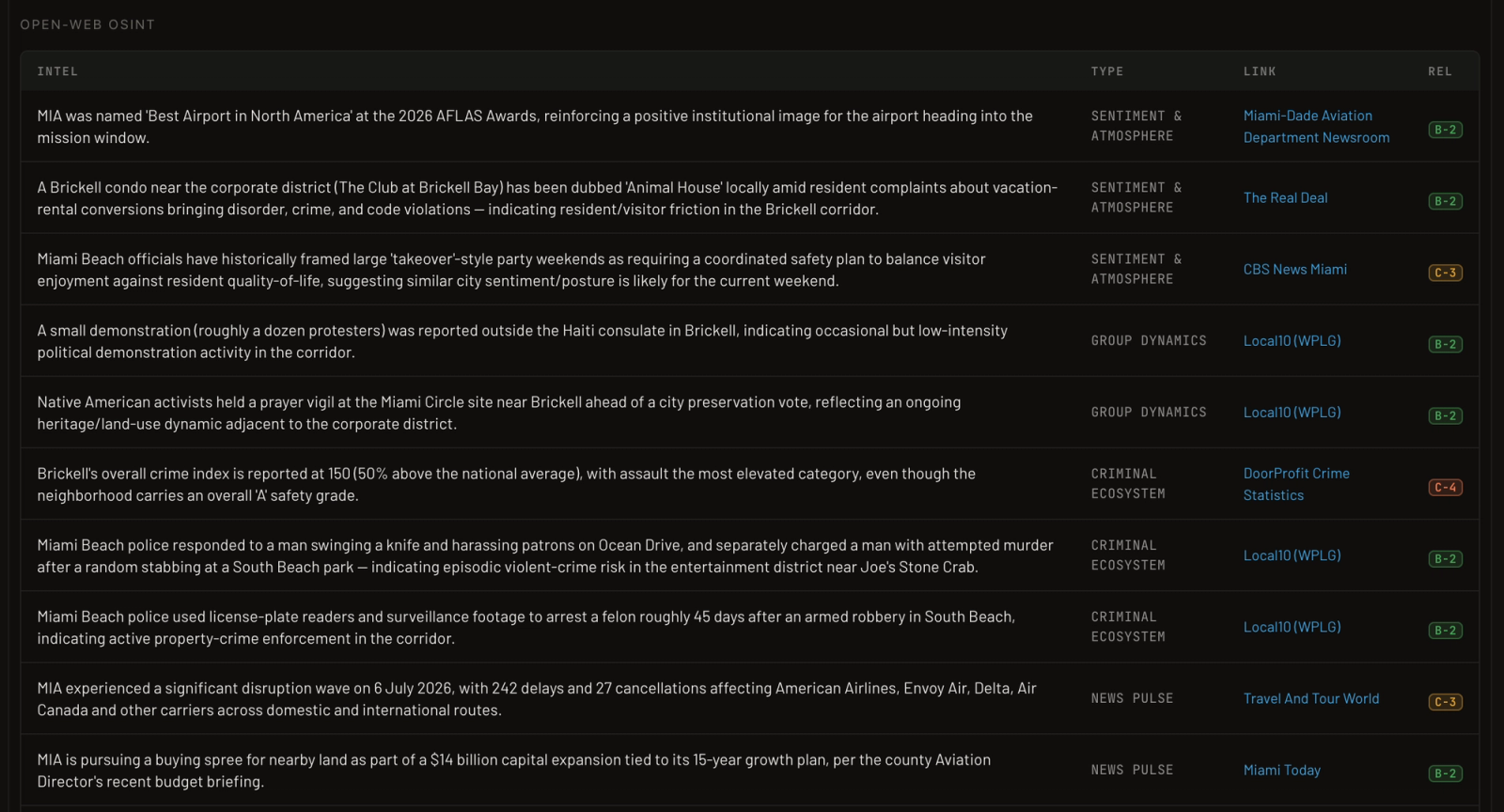
This isn't abstract for us — it's baked into how Arcline handles open-source intelligence for mission planning. The platform's collection runs mostly on OSINT: public event feeds, local reporting, and similar, pulled continuously and scoped to each active mission. That kind of material is exactly where source discipline matters most, because open sources are uneven by nature.
So rather than present a signal as a free-floating fact, Arcline keeps every item tied to where it came from — the source and the timestamp travel with the claim. An operator can follow any signal back to its origin and apply exactly the judgment above: who reported this, what's their track record, is it confirmed anywhere independent. We surface the material and its provenance; the rating and the decision stay with the operator. It's the two-axis habit, built into the tool instead of left to memory.
The habit under it all
Rating sources isn't paperwork. It's a thinking discipline that survives being busy: it separates "who told me" from "is it true," and keeps unconfirmed information from getting promoted to fact just because it arrived urgently or from someone you like. For teams making decisions off open sources under time pressure — most small teams, most of the time — that separation is the difference between acting on intelligence and acting on noise that felt like it.