
The Attention Problem at the Edge
Sensors, feeds, and compute keep getting cheaper at the tactical edge. Attention doesn't. The scarce resource in small-team operations has changed.
By Gavin Quinn
For most of the history of small-unit operations, the limiting factor was information: you couldn't see enough, soon enough. That constraint has inverted. The modern tactical edge — and its civilian equivalents in protective work, small law enforcement offices, and disaster response — is saturated with feeds, sensors, and reporting. The scarce resource is no longer collection. It's attention.
The inversion
The trend lines all point one direction. Sensors got cheap — commercial drones, fixed cameras, acoustic and RF detection at hobbyist prices. Data got cheap — satellite tasking is commercially purchasable, open-source reporting is global and near-instant, and every phone is a sensor someone is publishing from. Compute got small enough to wear.
Attention stayed fixed. A five-person team has five sets of eyes and the same cognitive ceiling humans have always had — less, under stress and sleep debt. Every new feed arrives claiming a slice of it.
The result is a bad trade at the edge: each additional source raises the theoretical ceiling on awareness while lowering the practical floor, because the operator now owns another stream to triage. Anyone who has run a TAK screen dense with icons, or kept eight browser tabs of feeds open during an advance, has felt the shape of it. More available information, less absorbed information.
Filtering is not the fix
The standard answer is filtering — geofences, keyword alerts, severity thresholds. Filters help, and every serious tool has them. But filters answer the wrong question. A geofence answers where is this happening? A keyword answers what words does it contain? Neither answers the question the operator actually has: does this touch my mission?
A road closure eight kilometers away is irrelevant by every geofence — unless it's on your alternate route. A minor protest permit is below every severity threshold — unless it's across from your venue during your window. Relevance isn't a property of the event. It's a property of the relationship between the event and your plan: your routes, your timings, your fixed points, your decision points. Static filters can't see that relationship, so they either flood the operator or starve them, and both failure modes cost the same scarce resource.
Mission-scoped attention
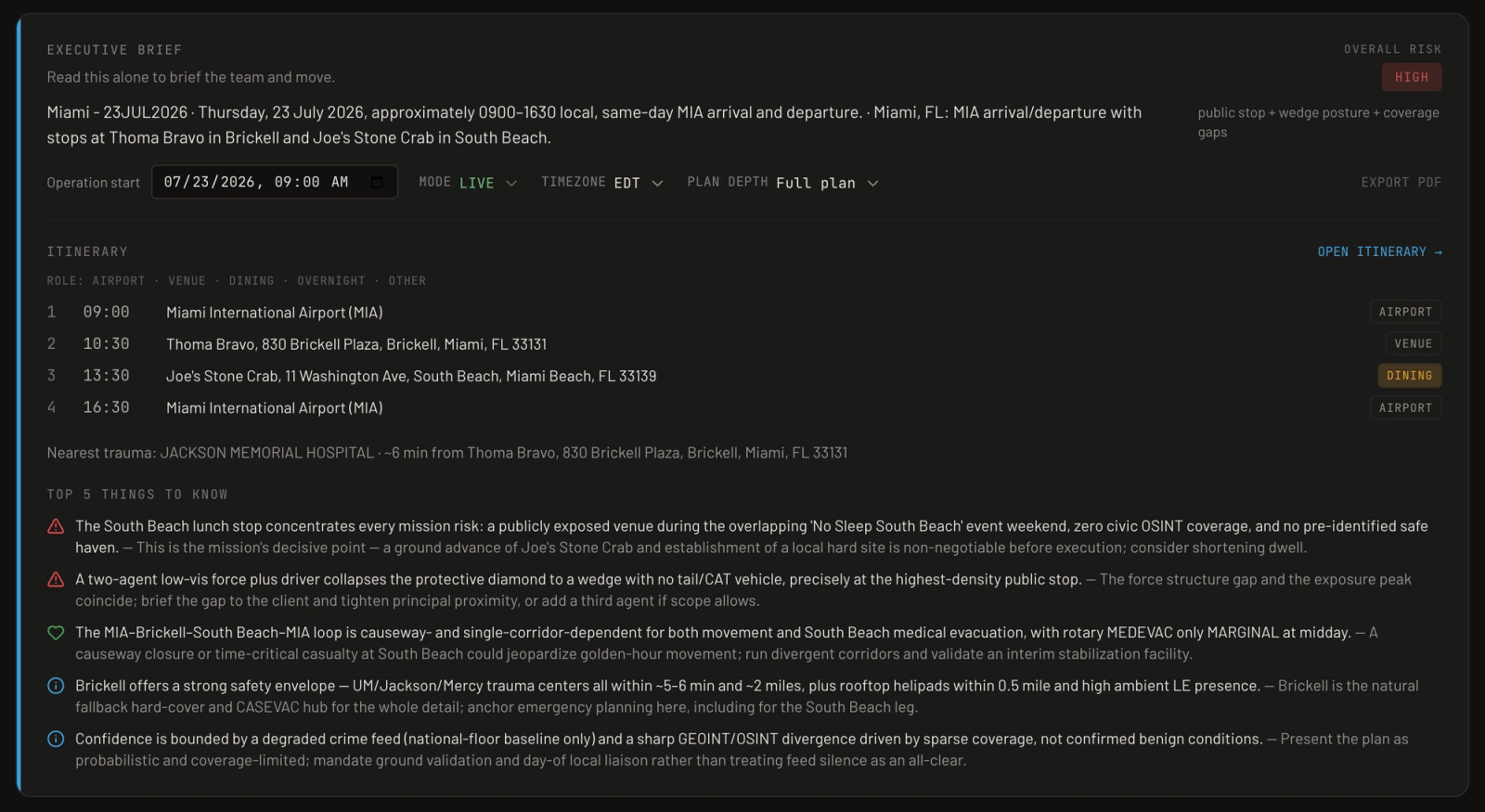
The alternative is to make the mission itself the filter. If the system knows the plan — locations, routes, timeline, the conditions that would force a decision — then incoming information can be weighed against something concrete: does this touch the plan or not?
That distinction is doctrine, older than any of the hardware. Collection management has always separated what's happening from what matters to this operation; named areas of interest and commander's critical information requirements exist precisely because staffs learned that unscoped information flow buries decision-makers. What's changed is that the discipline no longer requires a staff. The mechanical parts — cross-referencing every incoming report against every active mission's geometry and window, continuously, without fatigue — are exactly the parts machines do well and tired humans do worst.
The human part doesn't move. Deciding what the signal means, whether the plan changes, what the team does next: that stays with the operator, and any system that claims otherwise should be met with the skepticism operators already carry toward tools that promise judgment. The honest division of labor is narrower and more useful — the machine holds the watch; the human holds the decision.
What this predicts
If attention is the binding constraint, some predictions follow about where edge tooling has to go.
Displays stop being the bottleneck to improve. The edge already has good maps; adding icons to them is now negative progress. The layer that matters sits before the display — deciding what deserves a pixel at all.
Sensor count stops being a capability metric. A team's effective awareness is capped by what it can absorb, not what it can receive. Past that cap, additional feeds are load, not lift.
And the filter moves into the plan. Systems that understand mission geometry — not just location, but routes, windows, and decision points — become the difference between a team that is informed and a team that is merely subscribed.
None of this requires new hardware. It requires software that treats operator attention as the budget everything else is spent against. That is where the architecture points.