
The Hasty Advance: Order of Precedence When There's No Time
How to run a hasty advance in executive protection: the order of precedence, what never gets cut, and a phone-based method for 60–90 minutes.
By Arcline Team
A hasty advance is the compressed version of the protective advance: the same job, run when time does not allow the full one. The craft is not doing everything faster; it is knowing what to cut and what never gets cut.
The trip that drops tomorrow. The off-the-record stop the principal adds from the back seat. The two-hour warning on a venue nobody has seen. Every working detail lives with these. The teams that handle them well have already decided, before the clock starts, what matters most.
If you have the runway for the full version, run the full version. We covered what a complete security advance looks like separately, and nothing below replaces it. This is for when you do not.
A full advance is a luxury. A hasty advance is triage.
The mistake most people make under compression is running the full advance badly: touching everything, finishing nothing, and arriving with fifteen shallow answers instead of five solid ones. Triage works the other way. Decide the order of precedence first, work the list top down, and accept that the bottom may never get touched.
What follows is one way we sequence it. Adapt it to your team, your principal, and your threat picture. Every detail weights these differently, and should.
Never cut:
- Medical. The nearest trauma-capable facility and the route to it — not just the nearest hospital. A community hospital with no surgical capability is a detour, not a destination. Confirm the facility can actually take a trauma patient, and drive or at least map the route.
- Primary route with one alternate. Where you are going, how you get there, and one validated way out if the primary dies.
- The comms plan. Who calls whom when it goes wrong, in what order, on what channel. This takes ten minutes and fails more details than any route ever has.
- Arrival and departure points. The two moments of highest exposure. Know exactly where the vehicle stops, where the door is, and how far the gap is between them.
Cut second — degrade these before you drop them:
- Venue interior detail. You will not walk the building. Get the venue security or operations contact on the phone instead and let them walk it for you.
- Full alternate-route development. One solid, validated alternate beats three you pulled off a map and never checked.
- Written product polish. Voice notes and marked-up screenshots count. The brief matters; the formatting does not.
Cut first — these only matter at scale:
- Motorcade choreography for a two-car movement.
- Exhaustive photo documentation.
- Formal briefing decks.
If the movement is two vehicles and four people, the choreography annex was never going to earn its time back. Cut it without guilt.
The phone-based advance
Most of a hasty advance happens from a desk. In 60–90 minutes, before anyone moves, you can build a real picture — not a complete one, but a real one.
Call the venue. Ask for security or operations, not the front desk. The front desk will tell you the hours. The security manager will tell you which entrance the loading dock uses, where VIP drop-off actually happens, and what else is booked in the building that day.
Then pull the route in maps. Satellite view for the big picture, street view on the choke points: the arrival curb, the intersections that pinch, the last quarter mile. You are not driving it, so look hard at the places where a problem would concentrate.
Check what is happening around the location. Event calendars, local news, anything scheduled near the venue that day (a marathon, a demonstration, a stadium letting out at the wrong hour). If you have more runway than a day, monitoring the region before you travel is the better version of this step; compressed, it becomes a fifteen-minute sweep. A tight set of prepared search strings makes that sweep faster than improvising queries under pressure.
Confirm medical. Call or verify the trauma capability of the facility you selected. "Nearest hospital" from a map search is not an answer.
Get the local driver on the phone. If the movement uses a local driver, that call may be the highest-value fifteen minutes of the entire advance. Local knowledge beats a cold outsider survey. A driver who works that city every day knows which entrance actually gets used, which streets choke at that hour, and what the map does not show. You cannot learn a city in 72 hours. He already has.
A phone-based advance is not a substitute for eyes on the ground. It is what you do when eyes on the ground are not on the menu.
Put a clock on every block
Compression rewards discipline more than speed. Give each block a hard time box (one working split: 20 minutes on the route, 15 on the venue, 10 on medical, 10 on comms and the brief) and stop when the clock says stop, even mid-task. Adjust the numbers to the mission; keep the rule.
The specific allocation matters less than the clock itself. Without one, the route eats the whole window because routes are interesting, and medical gets three distracted minutes at the end. When a block's time expires, write down what you did not get to and move on. That list becomes the next product.
The un-covered list
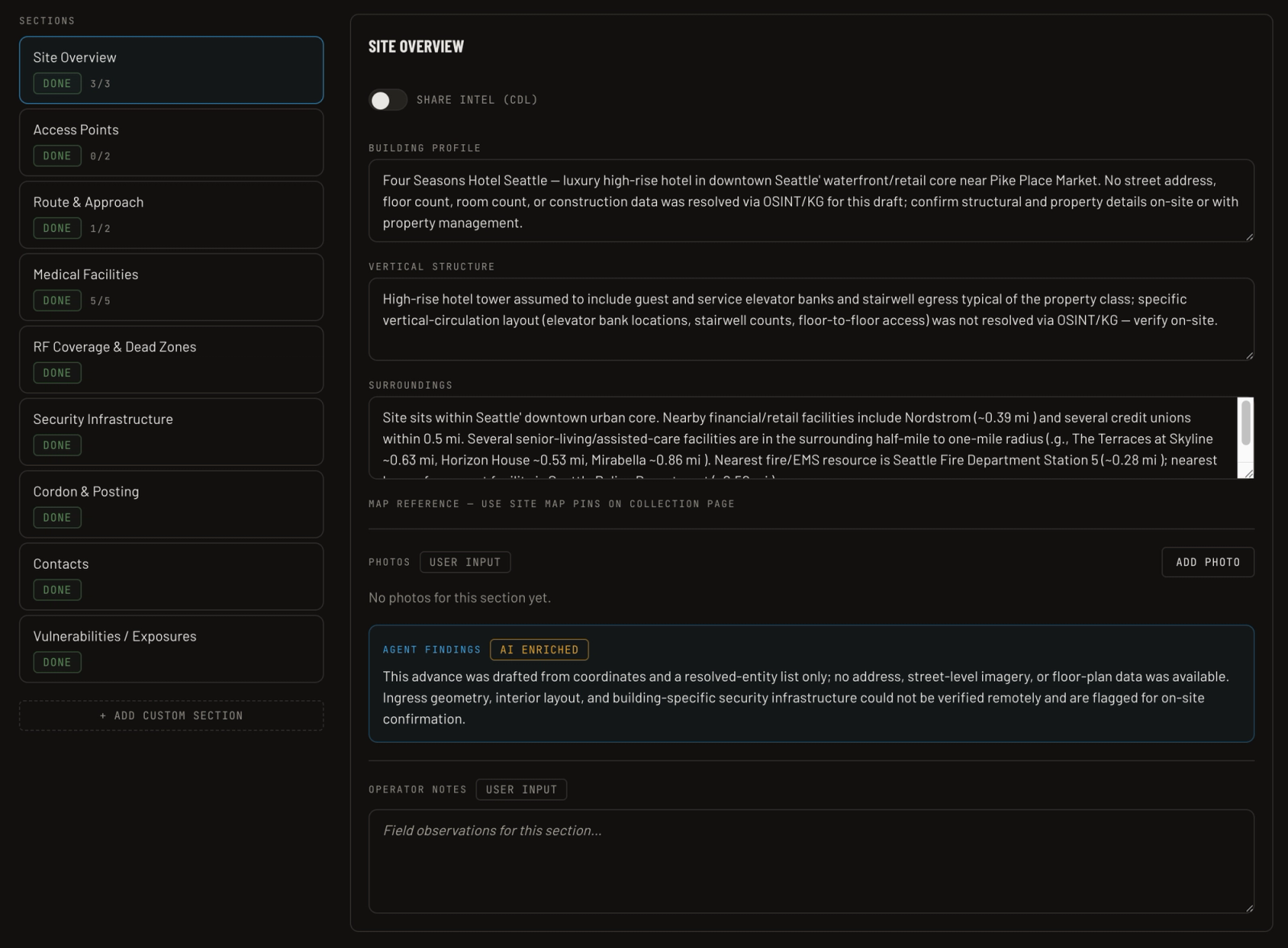
The most important product of a hasty advance is the explicit list of what was not checked, briefed directly to the detail lead.
Absence of a survey is not clearance. If nobody walked the interior, the interior is unknown — not fine, unknown — and the team on the ground should know exactly where the dark spots are so they can treat them accordingly: slower movement through unassessed spaces, a longer look before committing to an unvalidated alternate, a tighter formation at a door nobody has photographed.
The un-covered list turns a partial advance from a hidden liability into a managed one. The gaps do not shrink because you named them. But named gaps get watched, and unnamed ones get walked into.
A full advance and a hasty one differ in depth, not in candor. The distinction between a site survey and an advance survey still applies under compression; what changes is how much of each you can afford, and how plainly you report the remainder.
One person, one plan, clear ownership
On most small details, the hasty advance is one person on a phone and a laptop, not a cell of specialists. That reality shapes the last principle: ownership.
The team executing the mission owns the plan. Whoever runs the hasty advance (even solo, even brilliantly) is supporting the people who will drive the route and stand on the X, not directing them. Agents on the ground own route and path decisions in the moment, because they can see what the advance could not. And the principal has final say over their own movement, unless something is actively going wrong.
A hasty advance will not produce a perfect plan. What it can do is put the best available picture in front of the people making decisions at speed, including a clear-eyed map of where that picture goes dark.