
Why We Built Arcline
High-end planning tools serve large organizations. Small teams get spreadsheets and browser tabs. We built Arcline because we were those small teams.
By Arcline Team
Everyone who built Arcline came up in small-unit work — special operations teams, small unit law enforcement, protective details, the places where the team is a handful of people and the mission doesn't shrink to match. They are the reason Arcline exists
The bandwidth problem
On a small team, everyone is a specialist in multiple domains and responsible for a lot. The medic is also doing the route study. The comms guy is also building the area assessment. The team lead is doing their actual job plus quality control on all of it. Doctrine assumes a staff; the team is the staff.
What that looks like in practice is a bandwidth tax paid before the real work starts. Weather for the window, terrain along the routes, medical facilities mapped with routes to reach them, imagery pulled and marked up, local reporting scanned, the same checks re-run every day because the environment moved. None of this is the mission. All of it is prerequisite to the mission. And on a small team it comes out of the same hours that were supposed to go to rehearsals, contingencies, and equipment prep.
We lived versions of this in different uniforms. The no-support window is real: the stretch where there's no analyst to task, no section to call, nobody coming — just the team, the timeline, and a stack of preparation that has to be done manually or skipped. Teams get good at knowing what they're skipping. That knowledge is its own kind of weight.
The tooling gap
The strange part is that the software industry has solved most of this — for large organizations. Enterprise intelligence platforms are real and powerful, priced and staffed accordingly: they assume analysts, administrators, integration budgets, procurement cycles. At the other end sit mapping displays and shared documents — fine tools that hold what you produce but do none of the producing.
At the edge — where the work actually gets done — the team is small. A three-person detail. A split-team SOF mission. A relief crew running on whoever showed up. That's who Arcline is for: teams too small for enterprise tools, and too serious to get by on a doc and a map. Nobody built for them, because you couldn't reach them without shipping an analyst along with the software — or routing a license request through headquarters that needs 12 signatures and only runs on a Panasonic Toughbook. So the assumption never changed: someone on the team will do it by hand - because the mission has to get done and these teams aren’t quitters.
That's what changed. The tedious part of prep — gathering, cross-checking, mapping, watching — can now be handled by software that's simple enough for a small team to actually use when things are moving. Not a platform that needs a specialist to run it. Something that gets you ahead of where doing it by hand would leave you — without pretending it replaces the person making the call.
What Arcline actually does
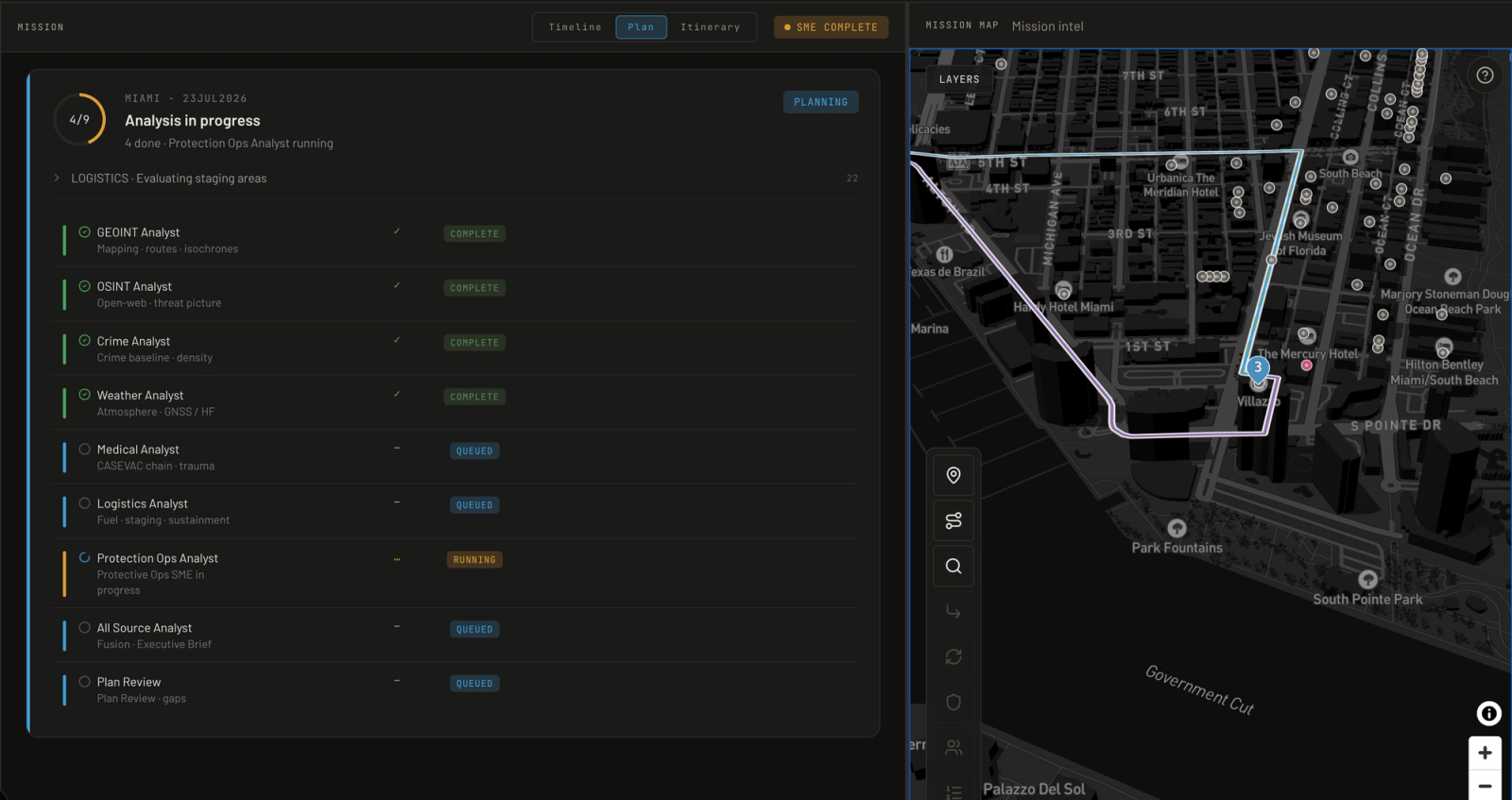
Arcline handles the layer beneath judgment. Weather, terrain, and route context assembled for the operating window. Medical and other key locations mapped, with the ground truth a team actually needs to reach them. Open-source reporting collected continuously and geocoded against each active mission — so the watching that nobody had time for happens anyway, from planning through execution. Every fact traced to its source, so nothing has to be taken on faith: check the claim, see where it came from, judge it yourself.
What it doesn't do is decide. The engine surfaces what's there; the operator weighs it. We're a team of people who don't extend trust to software easily, and we built the product to survive users like us — skeptics who want to see the source, not be handed a conclusion. That's also why every claim in the system carries its provenance. Trust that can't be checked isn't trust; it's exposure.
Why it matters
The point of automating the tedious layer isn't the layer. It's what the hours were supposed to buy. Time a team doesn't spend re-checking weather and re-scanning feeds is time spent on rehearsals, on walking the alternate route, on the contingency conversation, on team standards — the work that only humans can do and that small teams chronically underfund because the preparation tax comes first.
We hold the product to the same bar those teams hold their gear to: everything you carry has to earn its weight, and anything that doesn't gets left behind.
Arcline is being proven now across protective operations, law enforcement, and small military units. If you're running a mission set we might be able to help with, we'd like to hear about it.