
Site Survey vs Advance Survey: What Each Covers and When You Need Both
A site survey documents a single location. An advance survey builds the plan around a principal's movement. What each covers, and when you need both.
By Arcline Team
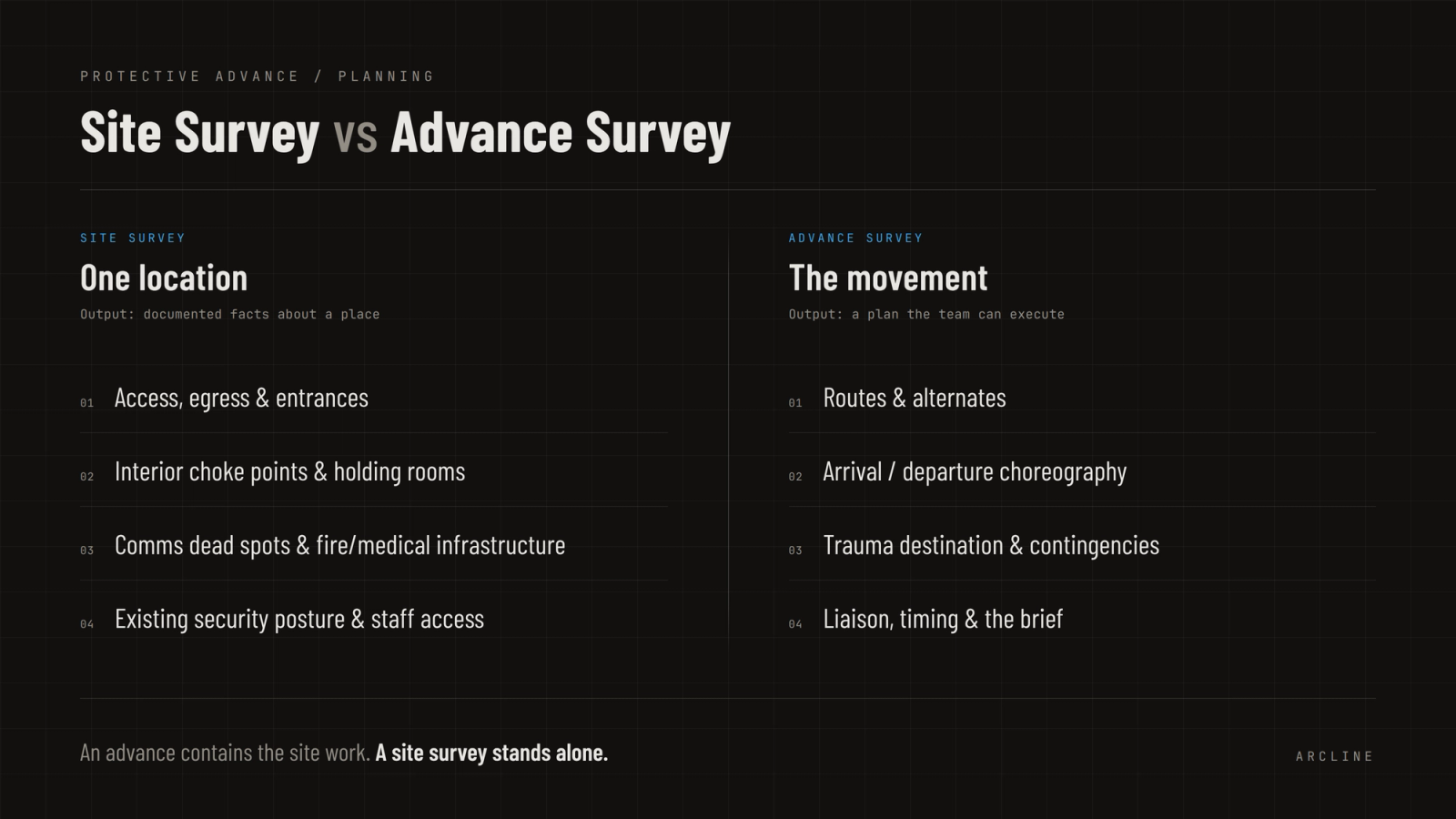
A site survey is a focused assessment of a single location: what exists there, how it operates, and where the problems are. An advance survey, the protective advance, is the broader preparatory effort around a principal's movement; it contains the site work, then adds routes, timing, medical planning, contingencies, and the brief that turns documented facts into a plan the team can execute.
The two terms get used interchangeably, and that causes real problems. A team that thinks it received an advance when it actually received a site survey shows up with facts about a building and no plan for anything between the vehicle and the door. Here's where the line sits, and how to decide which one the mission actually requires.
What a site survey covers
A site survey answers one question: what do we need to know about this place? The scope is a single location. A venue, a hotel, an office, a residence. One way we scope it, knowing every team adapts this to the venue and the threat picture:
- Access and egress: how people, vehicles, and the detail get in and out, and what controls those paths
- Entrances: primary, secondary, service, and which ones the detail will actually use
- Holding rooms: where the principal can be staged, secured, or worked on if something goes wrong
- Choke points inside the venue: stairwells, elevators, single-door corridors, anywhere movement compresses
- Emergency exits: where they lead, whether they're alarmed, whether they're actually unlocked
- Fire and medical infrastructure: extinguishers, AEDs, first aid stations, sprinkler coverage
- Communications dead spots: where radios and phones drop, especially sublevels and interior rooms
- Cameras and existing security posture: what's covered, who's watching, how house security operates
- Staff and vendor access: who else moves through the space, when, and under what control
- Parking and arrival points: where vehicles stage, drop, and pick up
The product of a site survey is documented facts about a place. That's it. The deliverable is facts: accurate, current, specific enough that someone who has never seen the venue can operate inside it.
What an advance survey adds
The advance wraps the site work inside everything the movement requires. If you're new to the term, start with what a security advance actually is; the short version is that the advance is preparation for a principal's movement, end to end. On top of the site survey, it adds:
- Routes and alternates — how the principal gets there and gets out, with backup options. Route work runs deep enough that we treat it separately in route surveys that hold up
- Motorcade and arrival-departure choreography — where vehicles stop, who opens which door, how long the principal is exposed between vehicle and threshold
- Medical planning — nearest trauma capability, not just nearest hospital. A community hospital without a trauma service is a detour, not a solution
- Contingency planning — what the team does when the primary plan breaks (relocation, evacuation, medical, communications failure)
- Liaison — venue contacts, local security, local law enforcement where appropriate, and who to call when something changes
- Timing — the schedule the movement actually runs on, including buffers
- The brief — the advance is finished only when the detail has been briefed and can execute without the advance agent standing next to them
A site survey produces facts about a place. An advance produces a plan a team can execute. That's the whole distinction.
Every advance includes site work — the reverse isn't true
The relationship is containment, not comparison. You cannot run a legitimate advance without surveying the sites involved. But a site survey by itself is not an advance, no matter how thorough it is. Ten pages of venue detail with no route, no medical plan, and no brief is an input, not a plan.
This matters most when someone hands you a document labeled "advance package" and it's actually a site survey. Read for the difference: does it tell you about the place, or does it tell the team what to do?
When a site survey alone is enough
Not every movement needs the full advance. Spending advance-level effort on every visit burns time a small team doesn't have. A bare site survey — or a review of an existing one — can carry the load when:
- The venue is recurring. The principal's office, a regular restaurant, a site the team has worked repeatedly. The advance already exists; the survey just needs to stay current
- The support is static. Event security at a fixed location, with no principal movement to plan around
- The exposure is low. A brief, unpublicized stop where the threat picture and the schedule don't justify full route and contingency work
The honest test: is there a movement to plan, or just a place to understand? If the principal's travel to and from the site carries the risk, a site survey alone leaves that risk unplanned.
Using someone else's site survey
Venue security, a partner firm, or a prior team may have already surveyed the location. Good. Use it. Redoing finished work wastes the hours you need for routes and contingencies. But validate before you rely on it:
- Check the date. Construction, renovations, staffing changes, and camera coverage all shift. Treat a six-month-old survey as a lead, and verify it
- Walk the critical paths yourself. Arrival point to holding room, holding room to exits. Trust their inventory of fire extinguishers; verify the paths your principal will actually move on
- Confirm the perishables. Comms dead spots, door hardware, exit alarms, and who holds keys change faster than floor plans do
- Ask what they didn't look at. Venue security surveys the venue's interests, not your principal's. Their document won't cover your arrival choreography or your holding room criteria unless someone asked
Validating is faster than redoing the work, and it catches the drift that makes old surveys dangerous.
The small-team reality
Doctrine describes the advance as a team effort. On most commercial details it's one person doing both jobs in a compressed window, sometimes the same afternoon as the movement. That reality shapes the work:
- You'll build a primary route and one alternate, maybe a third. Full PACE route planning is the standard to reach for, not the norm on a same-week tasking
- Sequence matters: site facts first, because routes and contingencies depend on them
- Local knowledge beats a cold walkthrough. The venue manager knows which exit alarm is broken. The local driver knows which route jams at 1700. The house security lead knows which camera is a prop. An outsider walking the site cold will miss what these people volunteer if asked
When the window compresses to hours instead of days, the work changes shape again. That's the hasty advance, and it deserves its own treatment.
Who owns the plan
The team executing the mission owns the plan. Not the advance agent who wrote it, not the survey it was built from, and not whoever surveyed the site last year.
The survey supports the agents on the ground. It doesn't outrank them.
Route and path decisions belong to the people moving with the principal, made against conditions as they find them. A good survey makes those decisions faster and better informed. A team that treats the survey as orders (following a documented route into a problem the document didn't predict) has inverted the relationship. Facts serve the plan. The plan serves the team, and the team decides.